Abstract.
As of 2026, everyone—including Anthropic/OpenAI/Sakana AI/SpaceX—is talking about
recursive self-improvement (RSI) or meta learning (learning to learn), and startups explicitly brand themselves as RSI companies. RSI is much older than that.
In 1987, when compute was about 108 times more expensive than today, I published the first concrete RSI algorithms in
my
diploma thesis [META1]
(Sec. 1).
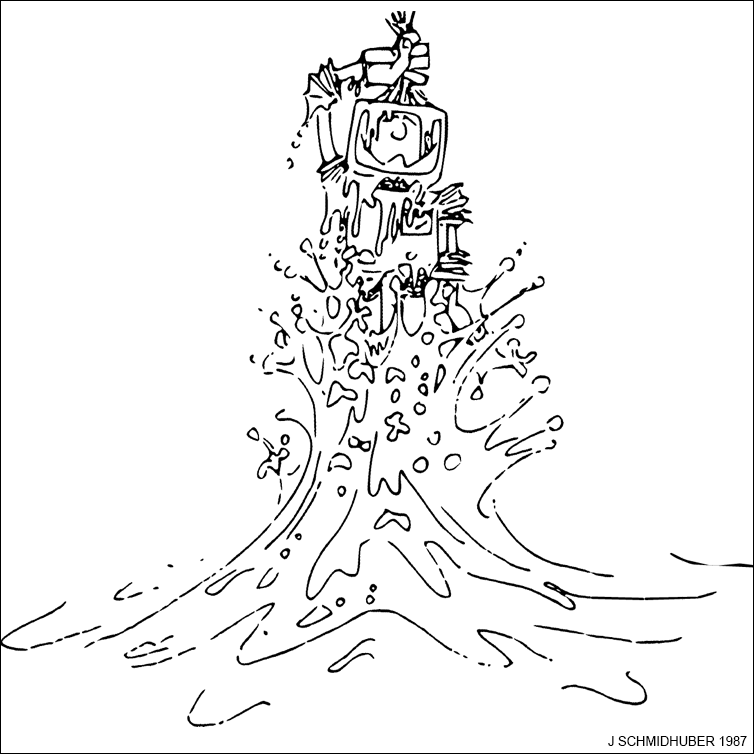
For its cover I drew a robot that bootstraps itself (image above).
[META1] was the first in a long series of publications on RSI, which became hot
in the 2010s
[DEC] and especially the 2020s.
Here I summarize our work on
RSI with
self-modifying policies since 1994 [METARL2-9]
(Sec. 2),
gradient descent-based RSI in artificial neural networks
since 1992 [FWPMETA1-10]
(Sec. 3),
asymptotically optimal RSI for curriculum learning since 2002 [OOPS1-3]
(Sec. 4),
mathematically optimal RSI through the
self-referential Gödel Machine since 2003 [GM3-9]
(Sec. 5),
RSI combined with artificial curiosity and intrinsic motivation [AC]
since 1990/1997 (Sec. 6),
and recent work on RSI since 2020 (Sec. 7).
See also this video tweet on RSI. Computing has become much cheaper, and software-based RSI has become practical. Full RSI, however, will require not just self-improving software but self-improving hardware in the physical world [DLH] (Sec. 9).
The most widely used machine learning algorithms were invented and hardwired by humans.
Can we also construct meta learning algorithms that can learn better learning
algorithms, to build truly self-improving AIs without any limits other than the limits of computability and physics?
This question has been a main drive of my research since
my 1987 diploma thesis on this topic [META1][AMA].
First note that meta learning is sometimes confused with simple transfer learning
from one training set to another (see N(eur)IPS 2016 slides).
However, even
a standard deep feedforward neural network (NN) [DLH][WHO4-11] can
transfer-learn to learn new images faster through pre-training on other image sets, e.g., [TRA12].
True meta learning and RSI is much more than that, and also
much more than just learning to adjust hyper-parameters
such as mutation rates in evolution strategies.
True RSI is about encoding the initial learning algorithm
in a universal programming
language (e.g., on a recurrent neural network or RNN), with primitive
instructions that allow for modifying the code itself
in arbitrary computable fashion. We surround this self-referential, self-modifying code
by a recursive framework that ensures that only "useful" self-modifications survive,
e.g., Sec. 2, Sec. 5.
Meta learning may be
the most ambitious but also the most
rewarding goal of machine learning.
There are few limits to what
a good meta learner will learn.
Where appropriate, it will learn to
learn by analogy, by chunking, by planning,
by subgoal generation, by combinations
thereof—you name it.
1. Meta Evolution and PSALMs (1987)
 In 1987, we published
[GP87] [GP] what I think was the first paper on
Genetic Programming or GP
for evolving programs of unlimited size written in
a universal programming language [GOD][GOD34][CHU][TUR][POS].
In 1987, we published
[GP87] [GP] what I think was the first paper on
Genetic Programming or GP
for evolving programs of unlimited size written in
a universal programming language [GOD][GOD34][CHU][TUR][POS].
In the same year, Sec. 2 of my diploma thesis [META1]
applied such GP to itself, to recursively evolve
better GP methods. There was not only a meta level but also a meta meta level and a meta meta meta level etc.
I called this RSI method Meta Evolution.
Sec. 4 of [META1] also introduced meta learning
Prototypical Self-Referential Associating Learning Mechanisms (PSALMs) for payoff maximisation
or Reinforcement Learning (RL).
This was a first kind of meta meta RL or RL-based RSI.
This work
concretizes aspects of I. J. Good's informal and speculative remarks (1966) on an "intelligence explosion" through self-improving "super-intelligences" [GOOD] (Good did not have any concrete RSI algorithms), and Bellman's thoughts on "metapolicies" (1967) [BE67].
2. RSI for Reinforcement Learning with Self-Modifying Policies (1994-)
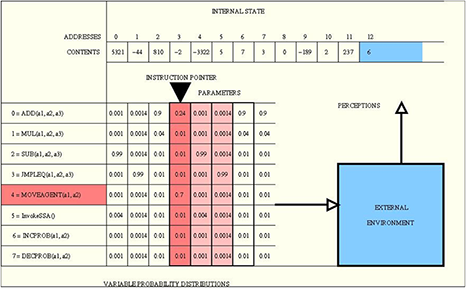 In 1994, I proposed another
type of meta RL or RSI called incremental self-improvement [METARL2] for
general purpose RL machines
with a single life consisting of
a single lifelong trial. That is, unlike in
traditional RL, there is no assumption of repeatable independent trials, and the RL
agent is never reset. It is driven by a
self-modifying policy
(SMP) which is a modifiable probability distribution over programs
written in a universal programming language [GOD][GOD34][CHU][TUR][POS], to allow for arbitrary computations.
The learning algorithm of an SMP
is part of the SMP itself—SMPs can modify the way
they modify themselves. The credit assignment process has to take into account that early self-modifications are setting the stage
for later ones.
In 1994, I proposed another
type of meta RL or RSI called incremental self-improvement [METARL2] for
general purpose RL machines
with a single life consisting of
a single lifelong trial. That is, unlike in
traditional RL, there is no assumption of repeatable independent trials, and the RL
agent is never reset. It is driven by a
self-modifying policy
(SMP) which is a modifiable probability distribution over programs
written in a universal programming language [GOD][GOD34][CHU][TUR][POS], to allow for arbitrary computations.
The learning algorithm of an SMP
is part of the SMP itself—SMPs can modify the way
they modify themselves. The credit assignment process has to take into account that early self-modifications are setting the stage
for later ones.
A method called
Environment-Independent Reinforcement Acceleration (EIRA) [METARL4] or
Success-Story Algorithm [METARL7-9]
forces SMPs to come
up with better and better self-modification algorithms that continually improve reward intake per time [METARL2-9]. This worked well in challenging experiments, although compute back then was 100,000 times more expensive than today. See
talk slides (2003)
or
N(eur)IPS WS 2018 overview slides and
this video tweet on RSI.
3. Gradient-Based RSI in NNs that Learn to Program Other NNs (1991) and Themselves (1992)
As I have frequently pointed out since 1990 [AC90],
the connection strengths or weights of
an artificial neural network (NN) should be viewed as its program.
Inspired by Gödel's universal self-referential formal systems [GOD][GOD34],
I built NNs whose outputs are programs or weight matrices of other NNs: the so-called Fast Weight Programmers [FWP0-2][FWP]. I even built
self-referential recurrent NNs (RNNs)
that can run and inspect their own weight change algorithms or learning algorithms [FWPMETA1-10].
A difference to Gödel's work was that my universal programming language was not based on the integers,
but on real-valued weights, such that
each NN's output is differentiable with respect to its program.
That is, a simple program generator (the efficient
gradient descent procedure [BP1]—compare [BP2] [BPA] [BP4] [R7])
can compute a direction in program space where one may find a better program [AC90],
in particular, a
better program-generating program [FWP0-2].
Much of my work since 1989 has exploited this fact.
Successful learning in deep architectures
started in 1965
when
Ivakhnenko & Lapa published the first general, working learning algorithms for deep multilayer perceptrons with arbitrarily many hidden layers. Their nets already contained the now popular multiplicative gates
[DEEP1-2] [DL1][DL2][DLH],
an essential ingredient of what was later called NNs with
dynamic links or
fast weights.
In 1981,
v. d. Malsburg was the first to explicitly emphasize the importance of NNs with such rapidly changing connections
[FAST]; others followed [DLP].
 However, these authors did not yet have an end-to-end differentiable system that learns by gradient descent to quickly manipulate the fast weight storage. Such a system I published in 1991 [FWP0][FWP1][ULTRA].
There a slow NN learns to control the weight changes of a separate fast NN.
That is, I separated storage and control like in traditional computers,
but in a fully neural way (rather than in a hybrid fashion [PDA1] [PDA2] [DNC]).
(Compare my related work on
what's now sometimes called
Synthetic Gradients [NAN1-5].)
However, these authors did not yet have an end-to-end differentiable system that learns by gradient descent to quickly manipulate the fast weight storage. Such a system I published in 1991 [FWP0][FWP1][ULTRA].
There a slow NN learns to control the weight changes of a separate fast NN.
That is, I separated storage and control like in traditional computers,
but in a fully neural way (rather than in a hybrid fashion [PDA1] [PDA2] [DNC]).
(Compare my related work on
what's now sometimes called
Synthetic Gradients [NAN1-5].)
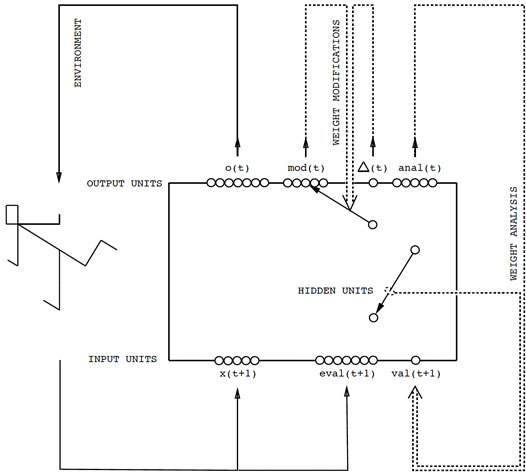 Then I showed how fast weights can be used for RSI or
"learning to learn."
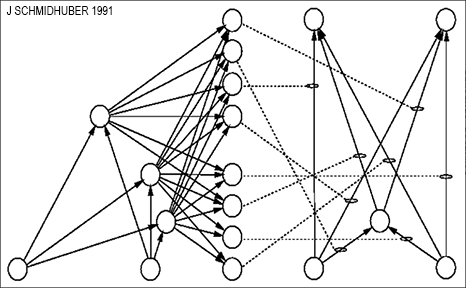
In references [FWPMETA1-5] since 1992, the slow RNN and the fast RNN are identical.
The RNN can see its own errors or reward signals called eval(t+1) in the image (from [FWPMETA5]).
The initial weight of each connection is trained by gradient descent, but during a training episode, each connection can be addressed
and read and modified by the RNN itself through O(log n) special output units, where n is the number of connections—see time-dependent vectors mod(t), anal(t), Δ(t), val(t+1) in the image. That is, each connection's weight may rapidly change, and the network becomes self-referential in the sense that it can in principle run arbitrary computable weight change algorithms or learning algorithms (for all of its weights) on itself: recursive self-improvement for NNs!
Then I showed how fast weights can be used for RSI or
"learning to learn."
In references [FWPMETA1-5] since 1992, the slow RNN and the fast RNN are identical.
The RNN can see its own errors or reward signals called eval(t+1) in the image (from [FWPMETA5]).
The initial weight of each connection is trained by gradient descent, but during a training episode, each connection can be addressed
and read and modified by the RNN itself through O(log n) special output units, where n is the number of connections—see time-dependent vectors mod(t), anal(t), Δ(t), val(t+1) in the image. That is, each connection's weight may rapidly change, and the network becomes self-referential in the sense that it can in principle run arbitrary computable weight change algorithms or learning algorithms (for all of its weights) on itself: recursive self-improvement for NNs!
In 1991-93, I simplified this through gradient descent-based, active control of fast weights through 2D tensors or outer product updates [FWP2] (compare our more recent work on this [FWP3] [FWP3a]).
One motivation
was to get many more temporal variables under massively parallel end-to-end differentiable control than what's possible in standard RNNs of the same size: O(H2) instead of O(H), where H is the number of hidden units (compare Sec. 8 of [MIR] and Sec. H4 of [DLP]).
The 1993
paper [FWP2]
also explicitly addressed the learning of
internal spotlights of attention
in end-to-end differentiable networks [FWP2] [ATT].
Unnormalized
Transformers with linearized self-attention[TR5-6] are formally equivalent to my 1991 outer product-based Fast Weight Programmers, now called unnormalized linear Transformers[ULTRA][MOST]—see the T in ChatGPT.
In 2001, my former student
Sepp Hochreiter
used gradient descent in LSTM networks [LSTM1] instead of traditional
RNNs to meta learn
fast online learning
algorithms for nontrivial classes of functions, such as all quadratic
functions of two variables [HO1].
4. Asymptotically Optimal RSI for Curriculum Learning (2002-)
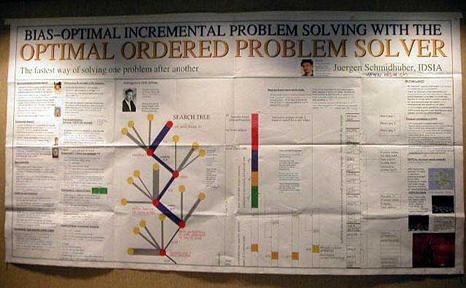 In 2002, I introduced a general and asymptotically time-optimal type of curriculum learning, that is, solving one problem after another, efficiently searching the space of programs that compute solution candidates, including those programs that organize and manage and adapt and reuse earlier acquired knowledge [OOPS1-3]. The
Optimal Ordered Problem Solver
(OOPS) draws inspiration from Levin's
Universal Search [OPT]
designed for single problems. It spends part of the total search time for a new problem on testing programs that exploit previous solution-computing programs in computable ways. If the new problem can be solved faster by copy-editing/invoking previous code than by solving the new problem from scratch, then OOPS will find this out. If not, then at least the previous solutions will not cause much harm. I introduced an efficient, recursive,
backtracking-based way of implementing OOPS
on realistic computers with limited storage. Experiments illustrated how OOPS can greatly profit from meta learning or meta searching, that is, searching for faster search procedures in RSI style [OOPS1-2]. The image shows my poster on OOPS at N(eur)IPS 2003.
In 2002, I introduced a general and asymptotically time-optimal type of curriculum learning, that is, solving one problem after another, efficiently searching the space of programs that compute solution candidates, including those programs that organize and manage and adapt and reuse earlier acquired knowledge [OOPS1-3]. The
Optimal Ordered Problem Solver
(OOPS) draws inspiration from Levin's
Universal Search [OPT]
designed for single problems. It spends part of the total search time for a new problem on testing programs that exploit previous solution-computing programs in computable ways. If the new problem can be solved faster by copy-editing/invoking previous code than by solving the new problem from scratch, then OOPS will find this out. If not, then at least the previous solutions will not cause much harm. I introduced an efficient, recursive,
backtracking-based way of implementing OOPS
on realistic computers with limited storage. Experiments illustrated how OOPS can greatly profit from meta learning or meta searching, that is, searching for faster search procedures in RSI style [OOPS1-2]. The image shows my poster on OOPS at N(eur)IPS 2003.
5. Optimal RSI: Self-Improving Gödel Machine (2003-)
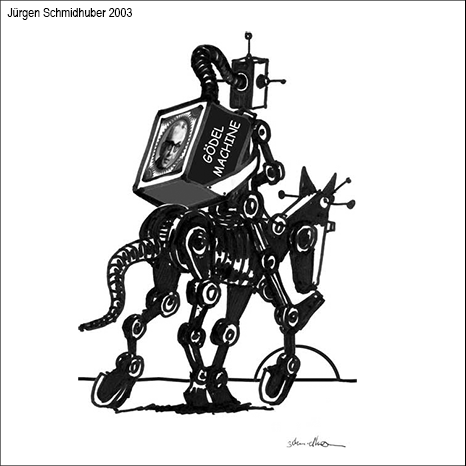 The self-referential RSI system of Sec. 2 above (1994-) justified its
self-modifications through growing statistical evidence of subsequent reward accelerations.
But it was not guaranteed to execute theoretically optimal self-improvements.
This motivated my
Gödel Machine [GM3-9], the first fully self-referential universal [UNI]
RSI machine that was indeed optimal in a certain mathematical sense.
Typically it uses the somewhat less general
Optimal Ordered Problem Solver
[OOPS1-2] (Sec. 4)
for finding provably optimal self-improvements.
The self-referential RSI system of Sec. 2 above (1994-) justified its
self-modifications through growing statistical evidence of subsequent reward accelerations.
But it was not guaranteed to execute theoretically optimal self-improvements.
This motivated my
Gödel Machine [GM3-9], the first fully self-referential universal [UNI]
RSI machine that was indeed optimal in a certain mathematical sense.
Typically it uses the somewhat less general
Optimal Ordered Problem Solver
[OOPS1-2] (Sec. 4)
for finding provably optimal self-improvements.
The RSI Gödel Machine is inspired by Kurt Gödel, the founder of theoretical computer science
in the early 1930s [GOD][GOD34][GOD21,a,b].
He introduced a universal coding language
based on the integers which
allows for formalizing the operations of any digital computer in axiomatic form.
Gödel used it to represent both data (such as axioms and theorems) and programs (such as proof-generating sequences of operations on the data).
He famously constructed formal statements that talk about the computation of other formal statements, especially self-referential statements which imply that their truth is not decidable by any computational theorem prover. Thus he identified fundamental limits of mathematics and theorem proving and computing and Artificial Intelligence (AI) [GOD][GOD21,a,b].
This had enormous impact on science and philosophy of the 20th century.
Furthermore, much of early AI in the 1940s-70s was actually about theorem proving and deduction in Gödel style through expert systems and logic programming.
Compare Sec. 18 of [MIR].
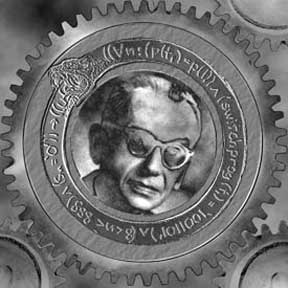 A Gödel Machine [GM6] is a general RL machine that will rewrite any part of its own code as soon as it has found a proof that the rewrite is useful, where the problem-dependent utility function and the hardware and the entire initial code are described by axioms encoded in an initial proof searcher which is also part of the initial code. While the machine is
interacting with its environment (initially in a suboptimal way),
the searcher systematically and efficiently tests computable proof techniques (programs whose outputs are proofs) until it finds a provably useful, computable self-rewrite. I showed that such a self-rewrite is globally optimal—no local maxima!—since the code first had to prove that it is not useful to continue the proof search for alternative self-rewrites. Unlike previous non-self-referential methods based on hardwired proof searchers, the Gödel Machine not only boasts an optimal order of complexity but can optimally reduce any slowdowns hidden by the O()-notation, provided the utility of such speed-ups is provable at all [GM3-9].
A Gödel Machine [GM6] is a general RL machine that will rewrite any part of its own code as soon as it has found a proof that the rewrite is useful, where the problem-dependent utility function and the hardware and the entire initial code are described by axioms encoded in an initial proof searcher which is also part of the initial code. While the machine is
interacting with its environment (initially in a suboptimal way),
the searcher systematically and efficiently tests computable proof techniques (programs whose outputs are proofs) until it finds a provably useful, computable self-rewrite. I showed that such a self-rewrite is globally optimal—no local maxima!—since the code first had to prove that it is not useful to continue the proof search for alternative self-rewrites. Unlike previous non-self-referential methods based on hardwired proof searchers, the Gödel Machine not only boasts an optimal order of complexity but can optimally reduce any slowdowns hidden by the O()-notation, provided the utility of such speed-ups is provable at all [GM3-9].
6. RSI plus Artificial Curiosity and Intrinsic Motivation (1990, 1997-)
 Before I continue the discussion of meta learning and RSI,
let me first explain RL with intrinsic motivation.
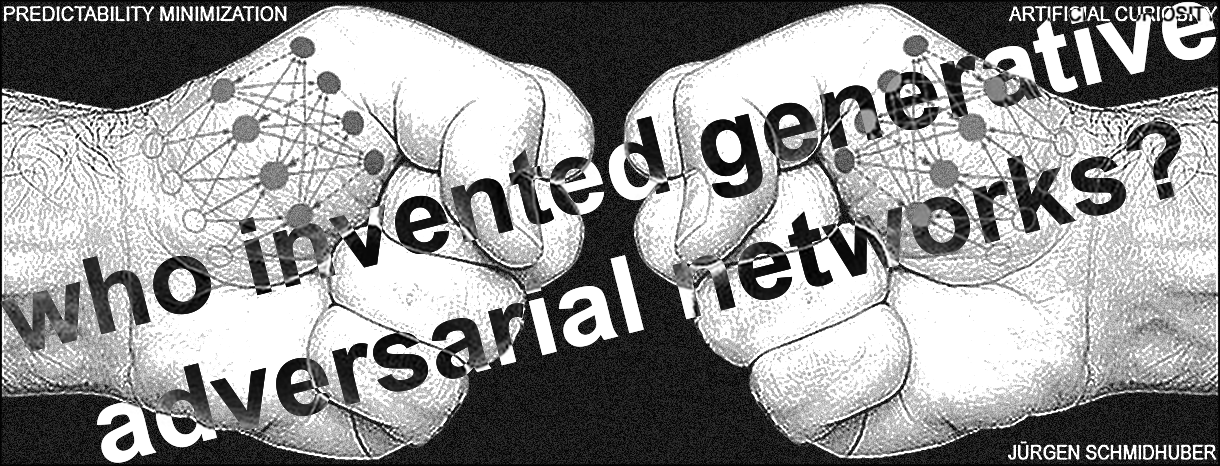
My popular principle of adversarial
artificial curiosity
from 1990 [AC90, AC90b] [AC20] (see also surveys [AC09] [AC10])
is now widely used not only for exploration in RL but also
for image synthesis [AC20][DLP]. It
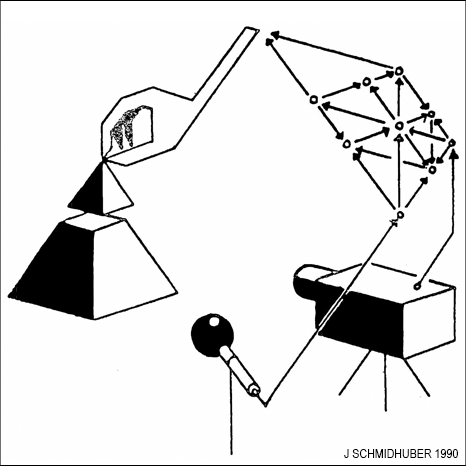
works as follows. One NN (the controller) probabilistically generates outputs, another NN (the world model) sees those outputs and predicts environmental reactions to them. Using gradient descent, the world model NN minimizes its error, while the generator NN tries to make outputs that maximize this error. One net's loss is the other net's gain.
So the controller is intrinsically motivated to generate output actions or experiments that
yield data from which the world model can still learn something.
(GANs are a special case of this where the environment simply returns 1 or 0 depending on whether the generator's output is in a given set [AC20]; compare [R2][LEC] and Sec. 5 of [MIR] and [WHO8].
Before I continue the discussion of meta learning and RSI,
let me first explain RL with intrinsic motivation.
My popular principle of adversarial
artificial curiosity
from 1990 [AC90, AC90b] [AC20] (see also surveys [AC09] [AC10])
is now widely used not only for exploration in RL but also
for image synthesis [AC20][DLP]. It
works as follows. One NN (the controller) probabilistically generates outputs, another NN (the world model) sees those outputs and predicts environmental reactions to them. Using gradient descent, the world model NN minimizes its error, while the generator NN tries to make outputs that maximize this error. One net's loss is the other net's gain.
So the controller is intrinsically motivated to generate output actions or experiments that
yield data from which the world model can still learn something.
(GANs are a special case of this where the environment simply returns 1 or 0 depending on whether the generator's output is in a given set [AC20]; compare [R2][LEC] and Sec. 5 of [MIR] and [WHO8].
 The Section "A Connection to Meta learning" in [AC90] (1990) already pointed out:
"A model network can be used not only for predicting the controller's inputs but also for predicting its future outputs. A perfect model of this kind would model the internal changes of the control network. It would predict the evolution of the controller, and thereby the effects of the gradient descent procedure itself. In this case, the flow of activation in the model network would model the weight changes of the control network. This in turn comes close to the notion of learning how to learn."
The paper [AC90] also introduced
planning with recurrent NNs (RNNs) as world models
[PLAN,PLAN2-5],
and high-dimensional reward signals.
Unlike in traditional RL,
those reward signals were also used as informative inputs to the controller NN
learning to execute actions that maximise cumulative reward
(see also Sec. 13 of [MIR]
and Sec. 5 of [DEC]).
The Section "A Connection to Meta learning" in [AC90] (1990) already pointed out:
"A model network can be used not only for predicting the controller's inputs but also for predicting its future outputs. A perfect model of this kind would model the internal changes of the control network. It would predict the evolution of the controller, and thereby the effects of the gradient descent procedure itself. In this case, the flow of activation in the model network would model the weight changes of the control network. This in turn comes close to the notion of learning how to learn."
The paper [AC90] also introduced
planning with recurrent NNs (RNNs) as world models
[PLAN,PLAN2-5],
and high-dimensional reward signals.
Unlike in traditional RL,
those reward signals were also used as informative inputs to the controller NN
learning to execute actions that maximise cumulative reward
(see also Sec. 13 of [MIR]
and Sec. 5 of [DEC]).
This is important for meta learning: an NN that cannot see its own errors or rewards cannot learn
a better way of using such signals as inputs for self-invented learning algorithms.
A few years later, I combined the RSI RL system of Sec. 2 and
Adversarial Artificial Curiosity in a single system [AC97, AC99, AC02].
It generates computational experiments in form of programs whose execution may change both an external environment and the RL agent's internal state. An experiment has a binary outcome: either a particular effect happens, or it doesn't. Experiments are collectively proposed by two reward-maximizing adversarial policies. Both can predict and bet on experimental outcomes before they happen. Once such an outcome is actually observed, the winner will get a positive reward proportional to the bet, and the loser a negative reward of equal magnitude. So each policy is motivated to create experiments whose yes/no outcomes surprise the other policy. The latter in turn is motivated to learn something about the world that it did not yet know, such that it is not outwitted again.
 Using RSI with
self-modifying policies [METARL2-9]
(Sec. 2),
the system learns when to learn and what to learn [AC97, AC99, AC02]. It
will also minimize the computational cost of learning new skills,
provided both brains receive a small
negative reward for each computational step, which
introduces a bias towards simple still surprising experiments (reflecting simple still unsolved problems). This may facilitate hierarchical construction of more and more complex experiments, including those yielding external reward (if there is any). In fact, this type of
artificial creativity
may not only drive artificial scientists and artists [AC06-09], but can also accelerate the intake of external reward [AC97] [AC02],
intuitively because a better understanding of the world can help to solve certain problems faster.
Using RSI with
self-modifying policies [METARL2-9]
(Sec. 2),
the system learns when to learn and what to learn [AC97, AC99, AC02]. It
will also minimize the computational cost of learning new skills,
provided both brains receive a small
negative reward for each computational step, which
introduces a bias towards simple still surprising experiments (reflecting simple still unsolved problems). This may facilitate hierarchical construction of more and more complex experiments, including those yielding external reward (if there is any). In fact, this type of
artificial creativity
may not only drive artificial scientists and artists [AC06-09], but can also accelerate the intake of external reward [AC97] [AC02],
intuitively because a better understanding of the world can help to solve certain problems faster.
The more recent, intrinsically motivated
PowerPlay RL system (2011) [PP] [PP1]
can use the meta learning
OOPS [OOPS1-2]
(Sec. 4) to
continually invent on its own new goals and tasks,
incrementally learning to become a more and more general problem solver in an active, partially unsupervised or self-supervised fashion.
RL robots with high-dimensional video inputs and intrinsic motivation (like in PowerPlay) learned to explore in 2015 [PP2].
7. More Recent Work on RSI and Meta Learning (2020-)
My former PhD student Imanol Schlag et al. [FWPMETA7] augmented an LSTM with an associative Fast Weight Memory (FWM). Through differentiable operations at every step of a given input sequence, the LSTM updates and maintains compositional associations of former observations stored in the rapidly changing FWM weights. The model is trained end-to-end by gradient descent and yields excellent performance on compositional language reasoning problems, small-scale word-level language modelling, and meta RL for
partially observable environments [FWPMETA7].
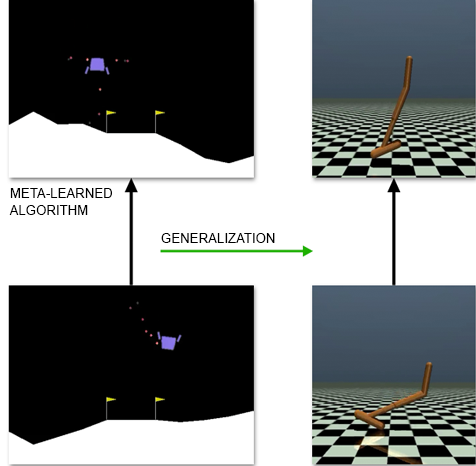 Our MetaGenRL (2020) [METARL10] meta learns
novel RL algorithms applicable to environments that significantly differ from those used for training.
MetaGenRL searches the space of low-complexity loss functions that describe such learning algorithms.
See the blog post of my former PhD student Louis Kirsch.
Our MetaGenRL (2020) [METARL10] meta learns
novel RL algorithms applicable to environments that significantly differ from those used for training.
MetaGenRL searches the space of low-complexity loss functions that describe such learning algorithms.
See the blog post of my former PhD student Louis Kirsch.
This principle of searching for simple learning algorithms is also applicable to fast weight architectures.
Our recent Variable Shared Meta Learning (VS-ML) merges weight sharing and sparsity in RSI RNNs [FWPMETA6].
This allows for encoding the learning algorithm by few parameters although it has many time-varying
variables—compare [FWP2] (Sec. 3).
VS-ML combines end-to-end differentiable fast weights [FWP1-3a] (Sec. 3) and learning algorithms encoded in the activations of LSTMs [HO1].
Some of these activations can be interpreted as NN weights updated by the LSTM dynamics.
LSTMs with shared sparse entries in their weight matrix discover learning algorithms that generalize to new datasets.
The meta learned learning algorithms do not require explicit gradient calculation.
VS-ML in RNNs can also learn to implement the famous backpropagation learning algorithm
[BP1]
[BP2]
[BP4]
purely in the end-to-end differentiable forward dynamics of RNNs [FWPMETA6].
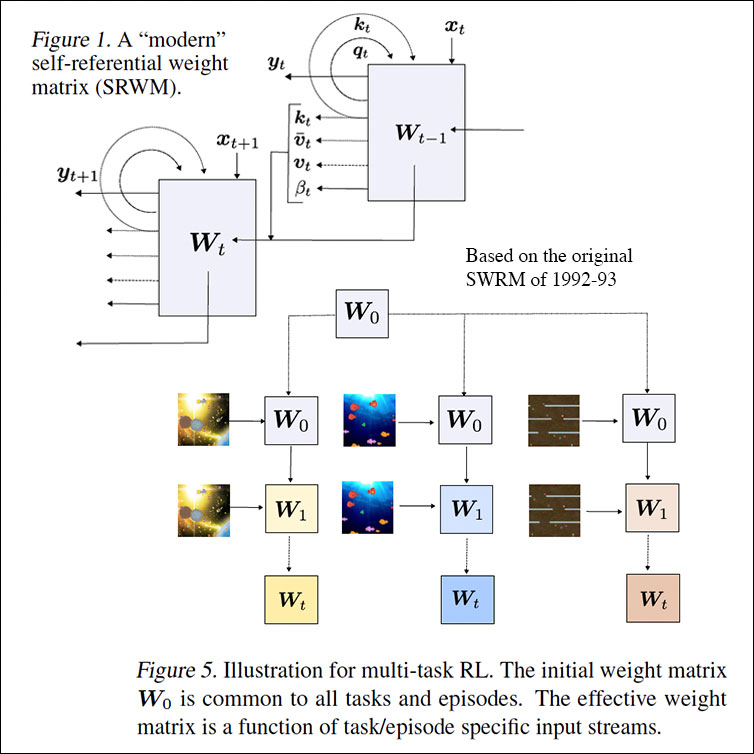
In 2022, we also published at ICML a modern self-referential weight matrix (SWRM) [FWPMETA8] based on the 1992 SWRM [FWPMETA1-5] (see Sec. 3). In principle, it can meta learn to learn, and meta meta learn to meta learn to learn, and so on, in the sense of recursive self-improvement (compare this tweet). We evaluated our SRWM on supervised few-shot learning tasks and on multi-task reinforcement learning with procedurally generated game environments. The experiments demonstrated both practical applicability and competitive performance of the SRWM.
Recent work on meta learning and RSI focused on LLM-based approaches inspired by the Gödel Machine [GM3-9]
(Sec. 5), e.g., the Darwin-Gödel Machine [GMD25] developed at Sakana AI, the Huxley-Gödel Machine [GMH26], and the Red Queen Gödel Machine [GMR26].
See our 2026 survey [RSI26].
Computing is much cheaper today than it was in the previous millennium, and finally, a number of companies are starting to focus on meta learning and RSI, e.g., Sakana AI, Ricursive, Recursive Superintelligence, Anthropic, OpenAI, Inherent, and others.
8. "In-Context Learning" of LLMs is a Special Case of Meta Learning
To a certain extent, recent Large Language Models (LLMs) can learn from a growing record of user interactions without changing the weights of the underlying pre-trained Transformer NN through gradient descent during test time.
This so-called "In-Context Learning" and "Test Time Training" of LLMs is a special case of meta learning, similar to the 1991 unnormalized linear Transformer [ULTRA] and the
2001 meta learning LSTM [HO1] which learned by gradient descent a learning algorithm for quadratic functions that was much faster than gradient descent (Sec. 3), without executing additional weight changes during test time [COCO]!
Generally speaking, gradient descent can be used to learn a learning algorithm running on the neural network itself, as shown in 1992 [FWPMETA1-5] (Sec. 3). Many meta learners actually
learn to program fast weights [FWP],
and Transformers do so too,
including the 1991 unnormalized linear Transformer [ULTRA][FWP0-1,6].
9. Full RSI Requires Self-Improving Hardware
The RSI discussion above focused on self-improving software. However, as pointed out earlier [DLH], to achieve True AI, software research per se is not enough, it has to be combined with the physical world of machines and robots. No Artificial Super Intelligence (ASI) without mastery of the real world! The Gödel Machine [GM3-9] (Sec. 5) takes this into account, and I'd like to end this report with a quote from [DLH] (based on earlier publications):
"For centuries, humans have discussed physical self-replicating machines (SRMs), including Descartes in the 1600s, Eliot and Butler in the 1800s, Capek in the 1920s, von Neumann & Zuse & Penrose and others since the 1940s [SRM20].
While self-replicating and evolving software is almost trivial (think of computer viruses), nobody knew how to build general purpose physical SRMs in practice. However, now there seems to be an obvious way:
AI-controlled general-purpose robots that can learn to operate all the machines and tools currently operated by humans [COG18] will also be able to build/operate/repair the machines required to make more of those robots.
This includes machines that mine the raw material from the ground, refine it, screw parts together, repair broken 3D printers and robots and robot factories, and so on, doing all the physical jobs that currently only machine-operating humans can do. Basically, a machine civilisation that can self-replicate without machine-operating humans, and then, of course, improve itself. Self-improving hardware, as opposed to the already existing, self-improving, meta-learning software.[META] I called this the ultimate form of scaling [JY24][FA24][95-25]."
Acknowledgments
 Thanks to several expert reviewers for useful comments. Since science is about self-correction, let me know under juergen@idsia.ch if you can spot any remaining error. The contents of this article may be used for educational and non-commercial purposes, including articles for Wikipedia and similar sites. This work is licensed under a Creative Commons Attribution-NonCommercial-ShareAlike 4.0 International License.
References
[95-25]
J. Schmidhuber (AI Blog, 2025).
1995-2025: The Decline of Germany & Japan vs US & China. Can All-Purpose Robots Fuel a Comeback? In 1995, in terms of nominal gross domestic product (GDP), a combined Germany and Japan were almost 1:1 economically with a combined USA and China, according to IMF. Only 3 decades later, this ratio is now down to 1:5! Self-replicating AI-driven all-purpose robots may be the answer.
Based on a 2024 F.A.Z. guest article.
[AC]
J. Schmidhuber (AI Blog, 2021). 3 decades of artificial curiosity & creativity. Our artificial scientists not only answer given questions but also invent new questions. They achieve curiosity through: (1990) the principle of generative adversarial networks, (1991) neural nets that maximise learning progress, (1995) neural nets that maximise information gain (optimally since 2011), (1997) adversarial design of surprising computational experiments, (2006) maximizing compression progress like scientists/artists/comedians do, (2011) PowerPlay... Since 2012: applications to real robots.
[AC90]
J. Schmidhuber.
Making the world differentiable: On using fully recurrent
self-supervised neural networks for dynamic reinforcement learning and
planning in non-stationary environments.
Technical Report FKI-126-90, TUM, Feb 1990, revised Nov 1990.
PDF.
The first paper on planning with reinforcement learning recurrent neural networks (NNs) and recurrent world models (more), and on generative adversarial networks
where a generator NN is fighting a predictor NN in a minimax game
(more).
Apparently, it was also the first paper of this kind to use the term "world model" for the predictor NN (although the basic concept of a world model is much older than that.)
[AC90b]
J. Schmidhuber.
A possibility for implementing curiosity and boredom in
model-building neural controllers.
In J. A. Meyer and S. W. Wilson, editors, Proc. of the
International Conference on Simulation
of Adaptive Behavior: From Animals to
Animats, pages 222-227. MIT Press/Bradford Books, 1991. Based on [AC90].
PDF.
More.
[AC91]
J. Schmidhuber. Adaptive confidence and adaptive curiosity. Technical Report FKI-149-91, Inst. f. Informatik, Tech. Univ. Munich, April 1991.
PDF.
[AC91b]
J. Schmidhuber.
Curious model-building control systems.
Proc. International Joint Conference on Neural Networks,
Singapore, volume 2, pages 1458-1463. IEEE, 1991.
PDF.
[AC95]
J. Storck, S. Hochreiter, and J. Schmidhuber. Reinforcement-driven information acquisition in non-deterministic environments. In Proc. ICANN'95, vol. 2, pages 159-164. EC2 & CIE, Paris, 1995. PDF.
[AC97]
J. Schmidhuber. What's interesting? Technical Report IDSIA-35-97, IDSIA, July 1997.
[AC99]
J. Schmidhuber.
Artificial Curiosity Based on Discovering Novel Algorithmic
Predictability Through Coevolution.
In P. Angeline, Z. Michalewicz, M. Schoenauer, X. Yao, Z.
Zalzala, eds., Congress on Evolutionary Computation, p. 1612-1618,
IEEE Press, Piscataway, NJ, 1999.
[AC02]
J. Schmidhuber.
Exploring the Predictable.
In Ghosh, S. Tsutsui, eds., Advances in Evolutionary Computing,
p. 579-612, Springer, 2002.
PDF.
[AC06]
J. Schmidhuber.
Developmental Robotics,
Optimal Artificial Curiosity, Creativity, Music, and the Fine Arts.
Connection Science, 18(2): 173-187, 2006.
PDF.
[AC09]
J. Schmidhuber. Art & science as by-products of the search for novel patterns, or data compressible in unknown yet learnable ways. In M. Botta (ed.), Et al. Edizioni, 2009, pp. 98-112.
PDF. (More on
artificial scientists and artists.)
[AC10]
J. Schmidhuber. Formal Theory of Creativity, Fun, and Intrinsic Motivation (1990-2010). IEEE Transactions on Autonomous Mental Development, 2(3):230-247, 2010.
IEEE link.
PDF.
[AC20]
J. Schmidhuber. Generative Adversarial Networks are Special Cases of Artificial Curiosity (1990) and also Closely Related to Predictability Minimization (1991).
Neural Networks, Volume 127, p 58-66, 2020.
Preprint arXiv/1906.04493.
[AMA] Schmidhuber (Reddit/ML, 2014). Ask Me Anything! Quote: "So what will be the real big thing? I like to believe that it will be self-referential general purpose learning algorithms that improve not only some system’s performance in a given domain, but also the way they learn, and the way they learn the way they learn, etc., limited only by the fundamental limits of computability."
[ATT] J. Schmidhuber (AI Blog, 2020). 30-year anniversary of end-to-end differentiable sequential neural attention. Plus goal-conditional reinforcement learning. We had both hard attention (1990) and soft attention (1991-93).[FWP] Today, both types are very popular.
[BE67]
R. Bellman. Adaptive processes and intelligent machines.
In Proceedings of the Fifth Berkeley Symposium on Mathematical Statistics and Probability, Vol. 4, pp. 11-14.
[BP1] S. Linnainmaa. The representation of the cumulative rounding error of an algorithm as a Taylor expansion of the local rounding errors. Master's Thesis (in Finnish), Univ. Helsinki, 1970.
See chapters 6-7 and FORTRAN code on pages 58-60.
PDF.
See also BIT 16, 146-160, 1976.
Link.
[BPA]
H. J. Kelley. Gradient Theory of Optimal Flight Paths. ARS Journal, Vol. 30, No. 10, pp. 947-954, 1960.
[BP2] P. J. Werbos. Applications of advances in nonlinear sensitivity analysis. In R. Drenick, F. Kozin, (eds): System Modeling and Optimization: Proc. IFIP,
Springer, 1982.
PDF.
[Extending thoughts in his 1974 thesis.]
[BP4] J. Schmidhuber (AI Blog, 2014; updated 2020).
Who invented backpropagation?
More.[DL2]
[CHU]
A. Church (1935). An unsolvable problem of elementary number theory. Bulletin of the American Mathematical Society, 41: 332-333. Abstract of a talk given on 19 April 1935, to the American Mathematical Society.
Also in American Journal of Mathematics, 58(2), 345-363 (1 Apr 1936).
First explicit proof that the Entscheidungsproblem (decision problem) does not have a general solution.
[COCO]
N.E. Cotter and P.R. Conwell (1990).
Fixed-weight networks can learn.
International Joint Conference on Neural Networks IJCNN'1990.
[COG18]
J. Schmidhuber. Talk for CogX, London, 2018. YouTube video.
[DEC] J. Schmidhuber (AI Blog, 02/20/2020, revised 2021). The 2010s: Our Decade of Deep Learning / Outlook on the 2020s. The recent decade's most important developments and industrial applications based on our AI, with an outlook on the 2020s, also addressing privacy and data markets.
[DEEP1]
Ivakhnenko, A. G. and Lapa, V. G. (1965). Cybernetic Predicting Devices. CCM Information Corporation. First working Deep Learners with many layers, learning internal representations.
[DEEP1a]
Ivakhnenko, Alexey Grigorevich. The group method of data of handling; a rival of the method of stochastic approximation. Soviet Automatic Control 13 (1968): 43-55.
[DEEP2]
Ivakhnenko, A. G. (1971). Polynomial theory of complex systems. IEEE Transactions on Systems, Man and Cybernetics, (4):364-378.
[DL1] J. Schmidhuber, 2015.
Deep learning in neural networks: An overview. Neural Networks, 61, 85-117.
More.
Got the first Best Paper Award ever issued by the journal Neural Networks, founded in 1988.
[DL2] J. Schmidhuber, 2015.
Deep Learning.
Scholarpedia, 10(11):32832.
[DL4] J. Schmidhuber (AI Blog, 2017).
Our impact on the world's most valuable public companies: Apple, Google, Microsoft, Facebook, Amazon... By 2015-17, neural nets developed in my labs were on over 3 billion devices such as smartphones, and used many billions of times per day, consuming a significant fraction of the world's compute. Examples: greatly improved (CTC-based) speech recognition on all Android phones, greatly improved machine translation through Google Translate and Facebook (over 4 billion LSTM-based translations per day), Apple's Siri and Quicktype on all iPhones, the answers of Amazon's Alexa, etc. Google's 2019
on-device speech recognition
(on the phone, not the server)
is still based on
LSTM.
[DL6]
F. Gomez and J. Schmidhuber.
Co-evolving recurrent neurons learn deep memory POMDPs.
In Proc. GECCO'05, Washington, D. C.,
pp. 1795-1802, ACM Press, New York, NY, USA, 2005.
PDF.
[DL6a]
J. Schmidhuber (AI Blog, Nov 2020). 15-year anniversary: 1st paper with "learn deep" in the title (2005). Our deep reinforcement learning & neuroevolution solved problems of depth 1000 and more.[DL6] Soon after its publication, everybody started talking about "deep learning." Causality or correlation?
[DLH]
J. Schmidhuber.
Annotated History of Modern AI and Deep Learning. Technical Report IDSIA-22-22, IDSIA, Switzerland, 2022, updated 2025.
Preprint arXiv:2212.11279.
Tweet.
[DLP]
J. Schmidhuber.
How 3 Turing awardees republished key methods and ideas whose creators they failed to credit. Technical Report IDSIA-23-23, Swiss AI Lab IDSIA, 14 Dec 2023, updated 2025.
Tweet of 2023.

[DNC] Hybrid computing using a neural network with dynamic external memory.
A. Graves, G. Wayne, M. Reynolds, T. Harley, I. Danihelka, A. Grabska-Barwinska, S. G. Colmenarejo, E. Grefenstette, T. Ramalho, J. Agapiou, A. P. Badia, K. M. Hermann, Y. Zwols, G. Ostrovski, A. Cain, H. King, C. Summerfield, P. Blunsom, K. Kavukcuoglu, D. Hassabis.
Nature, 538:7626, p 471, 2016.
[FA15]
J. Schmidhuber.
Intelligente Roboter werden vom Leben fasziniert sein.
(Intelligent robots will be fascinated by life.)
FAZ, 1 Dec 2015.
Link.
[FA18]
J. Schmidhuber.
KI ist eine Riesenchance für Deutschland.
(AI is a huge chance for Germany.)
FAZ, 2018.
Link.
[FA24]
J. Schmidhuber.
Baut den KI-gesteuerten Allzweckroboter!
(Build the AI-controlled all-purpose robot!)
FAZ, 2024.
Link.
[FAST] C. v.d. Malsburg. Tech Report 81-2, Abteilung f. Neurobiologie,
Max-Planck Institut f. Biophysik und Chemie, Goettingen, 1981.
First paper on fast weights or dynamic links.
[FASTa]
J. A. Feldman. Dynamic connections in neural networks.
Biological Cybernetics, 46(1):27-39, 1982.
2nd paper on fast weights.
[FWP]
J. Schmidhuber (AI Blog, 26 March 2021, updated 2023, 2025).
26 March 1991: Neural nets learn to program neural nets with fast weights—like Transformer variants. 2021: New stuff!
See tweet of 2022.
[FWP0]
J. Schmidhuber.
Learning to control fast-weight memories: An alternative to recurrent nets.
Technical Report FKI-147-91, Institut für Informatik, Technische
Universität München, 26 March 1991.
PDF.
First paper on neural fast weight programmers that separate storage and control: a slow net learns by gradient descent to compute weight changes of a fast net. The outer product-based version (Eq. 5) is now known as the unnormalized linear Transformer or the "Transformer with linearized self-attention."[ULTRA][FWP]
[FWP1] J. Schmidhuber. Learning to control fast-weight memories: An alternative to recurrent nets. Neural Computation, 4(1):131-139, 1992. Based on [FWP0].
PDF.
HTML.
Pictures (German).
See tweet of 2022 for 30-year anniversary.
[FWP2] J. Schmidhuber. Reducing the ratio between learning complexity and number of time-varying variables in fully recurrent nets. In Proceedings of the International Conference on Artificial Neural Networks, Amsterdam, pages 460-463. Springer, 1993.
PDF.
A recurrent extension of the 1991 unnormalized linear Transformer,[ULTRA] introducing the terminology of learning "internal spotlights of attention." First recurrent NN-based fast weight programmer using outer products to program weight matrix changes.
[FWP3] I. Schlag, J. Schmidhuber. Gated Fast Weights for On-The-Fly Neural Program Generation. Workshop on Meta Learning, @N(eur)IPS 2017, Long Beach, CA, USA.
[FWP3a] I. Schlag, J. Schmidhuber. Learning to Reason with Third Order Tensor Products. Advances in Neural Information Processing Systems (N(eur)IPS), Montreal, 2018.
Preprint: arXiv:1811.12143. PDF.
[FWP6] I. Schlag, K. Irie, J. Schmidhuber.
Linear Transformers Are Secretly Fast Weight Programmers. ICML 2021. Preprint: arXiv:2102.11174.
[FWP7] K. Irie, I. Schlag, R. Csordas, J. Schmidhuber.
Going Beyond Linear Transformers with Recurrent Fast Weight Programmers.
NeurIPS 2021.
Preprint: arXiv:2106.06295 (June 2021).
[FWP8] K. Irie, F. Faccio, J. Schmidhuber.
Neural Differential Equations for Learning to Program Neural Nets Through Continuous Learning Rules.
NeurIPS 2022.
[FWP9] K. Irie, J. Schmidhuber.
Images as Weight Matrices: Sequential Image Generation Through Synaptic Learning Rules.
ICLR 2023.
[FWPMETA1] J. Schmidhuber. Steps towards `self-referential' learning. Technical Report CU-CS-627-92, Dept. of Comp. Sci., University of Colorado at Boulder, November 1992.
PDF.
[FWPMETA2] J. Schmidhuber. A self-referential weight matrix.
In Proceedings of the International Conference on Artificial
Neural Networks, Amsterdam, pages 446-451. Springer, 1993.
PDF.
[FWPMETA3] J. Schmidhuber.
An introspective network that can learn to run its own weight change algorithm. In Proc. of the Intl. Conf. on Artificial Neural Networks,
Brighton, pages 191-195. IEE, 1993.
[FWPMETA4]
J. Schmidhuber.
A neural network that embeds its own meta levels.
In Proc. of the International Conference on Neural Networks '93,
San Francisco. IEEE, 1993.
[FWPMETA5]
J. Schmidhuber. Habilitation thesis, TUM, 1993. PDF.
A recurrent neural net with a self-referential, self-reading, self-modifying weight matrix
can be found here.
[FWPMETA6]
L. Kirsch and J. Schmidhuber. Meta Learning Backpropagation & Improving It. Meta learning Workshop at NeurIPS, 2020.
Preprint arXiv:2012.14905 [cs.LG], 2020.
[FWPMETA7]
I. Schlag, T. Munkhdalai, J. Schmidhuber.
Learning Associative Inference Using Fast Weight Memory.
Report arXiv:2011.07831 [cs.AI], 2020.
[FWPMETA8]
K. Irie, I. Schlag, R. Csordas, J. Schmidhuber.
A Modern Self-Referential Weight Matrix That Learns to Modify Itself.
International Conference on Machine Learning (ICML), 2022.
Preprint: arXiv:2202.05780.
[FWPMETA9]
L. Kirsch and J. Schmidhuber.
Self-Referential Meta Learning.
First Conference on Automated Machine Learning (Late-Breaking Workshop), 2022.
[FWPMETA10] K. Irie, R. Csordas, J. Schmidhuber.
Meta learning Continual Learning Algorithms.
TMLR 2025 (Schmidhuber's 100th journal publication).
Preprint (2023) on "Automating Continual Learning:" arXiv:2312.00276v1.
[GM3]
J. Schmidhuber (2003).
Goedel Machines: Self-Referential Universal Problem Solvers Making Provably Optimal Self-Improvements.
Preprint
arXiv:cs/0309048 (2003).
More.
[GM6]
J. Schmidhuber (2006).
Gödel machines:
Fully Self-Referential Optimal Universal Self-Improvers.
In B. Goertzel and C. Pennachin, eds.: Artificial
General Intelligence, p. 199-226, 2006.
PDF.
[GM9]
J. Schmidhuber (2009).
Ultimate Cognition à la Gödel.
Cognitive Computation 1(2):177-193, 2009. PDF.
More.
[GMD25]
J. Zhang, S. Hu, C. Lu, R. Lange, J. Clune.
Darwin Gödel Machine: Open-Ended Evolution of Self-Improving Agents.
Fourteenth International Conference on Learning Representations (ICLR), 2026. Developed at Sakana AI.
Preprint: arXiv:2505.22954.
[GMH26]
W. Wang, P. Piękos, L. Nanbo, F. Laakom, Y. Chen, M. Ostaszewski, M. Zhuge, J. Schmidhuber.
Huxley-Gödel Machine: Human-Level Coding Agent Development by an Approximation of the Optimal Self-Improving Machine.
International Conference on Learning Representations ICLR 2026.
Preprint: arXiv:2510.21614.
[GMR26]
A. Iacob, A. Jovanovic, W. F. Shen, D. Burkhardt, M. Kurmanji, N. Tastan, L. Sani, N. Alberto, E. Venanzi, A. Odonnat, Z. Cao, B. Marino, X. Qiu, N. D. Lane. The Red Queen Gödel machine:
Co-evolving agents and their evaluators, 2026.
Preprint: arXiv:2606.26294.
[GOOD]
Good, I. J. (1966). Speculations concerning the first ultraintelligent machine. In Advances in computers, Vol. 6, pp. 31-88, Elsevier.
[GOD]
K. Gödel. Über formal unentscheidbare Sätze der Principia Mathematica und verwandter Systeme I. Monatshefte für Mathematik und Physik, 38:173-198, 1931.
[In the early 1930s, Gödel founded theoretical computer science. He identified fundamental limits of mathematics and theorem proving and computing and Artificial Intelligence.]
[GOD34]
K. Gödel (1934).
On undecidable propositions of formal mathematical
systems. Notes by S. C. Kleene and J. B. Rosser on lectures
at the Institute for Advanced Study, Princeton, New Jersey, 1934, 30
pp. (Reprinted in M. Davis, (ed.), The Undecidable. Basic Papers on Undecidable
Propositions, Unsolvable Problems, and Computable Functions,
Raven Press, Hewlett, New York, 1965.)
[Gödel introduced a universal coding language.]
[GOD21] J. Schmidhuber (AI Blog, 2021). 90th anniversary celebrations: 1931: Kurt Gödel, founder of theoretical computer science, shows limits of math, logic, computing, and artificial intelligence. This was number 1 on Hacker News.
[GOD21a]
J. Schmidhuber (2021). Als Kurt Gödel die Grenzen des Berechenbaren entdeckte.
(When Kurt Gödel discovered the limits of computability.)
Frankfurter Allgemeine Zeitung, 16/6/2021.
[GOD21b]
J. Schmidhuber (AI Blog, 2021). 80. Jahrestag: 1931: Kurt Gödel, Vater der theoretischen Informatik, entdeckt die Grenzen des Berechenbaren und der künstlichen Intelligenz.
[GP87]
D. Dickmanns, J. Schmidhuber, A. Winklhofer: Der genetische Algorithmus: Eine Implementierung in Prolog. Fortgeschrittenenpraktikum, Institut f. Informatik, Lehrstuhl Prof. Radig, Tech. Univ. Munich, 1987. Probably the first work on Genetic Programming for evolving programs
of unlimited size written in a universal coding language. Based on work I did since 1985 on a Symbolics Lisp Machine of SIEMENS AG. Authors in alphabetical order. More.
[GP]
J. Schmidhuber, 2020.
Genetic Programming for code of unlimited size (1987)
[HO1]
S. Hochreiter, A. S. Younger, P. R. Conwell (2001). Learning to Learn Using Gradient Descent.
ICANN 2001. Lecture Notes in Computer Science, 2130, pp. 87-94.
[JY24]
The Father of Generative AI Without Turing Award. Jazzyear.com interviews J. Schmidhuber (August 2024). Quote: "What's next? It’s true AGI in the physical world, not just today’s AI behind the screen. The physical challenges of the real world are far more complex than those of the virtual one. AI still has a long way to go before it can replace skilled trades like plumbers or electricians. However, there is reason to believe AI in the physical world will soon make significant strides.
A next major step will be self-replicating and self-improving societies of physical robots and other machines. We already have 3D printers that can print copies of parts of themselves. But no 3D printer can make a complete copy of itself, like a living being. To assemble a complete 3D printer, you need many other machines, for example, to take the raw material out of the ground, to refine it, to make the machines that make the machines that help make many unprintable parts of the 3D printer, to screw those parts together, and so on. Most importantly, you still need lots of people to oversee and manage all this, and to fix broken machines.
Eventually, however, there will be entire societies of clever and not-so-clever physical machines that can collectively build from scratch all the things needed to make copies of themselves, mine the raw materials they need, repair broken robots and robot factories, and so on. Basically, a machine civilisation that can make copies of itself and then, of course, improve itself. Basically, I am talking about a new form of life, about self-replicating, self-maintaining, self-improving hardware, as opposed to the already existing, self-improving, machine-learning software.
There will be enormous commercial pressure to create such life-like hardware, because it represents the ultimate form of scaling, and its owners will become very rich, because economic growth is all about scaling.
Of course, such life-like hardware won't be confined to our little biosphere. No, variants of it will soon exist on other planets, or between planets, e.g. in the asteroid belt. As I have said many times in recent decades, space is hostile to humans but friendly to suitably designed robots, and it offers many more resources than our thin layer of biosphere, which receives less than a billionth of the energy of the Sun. Through life-like, self-replicating, self-maintaining hardware, the economy of our solar system will become billions of times larger than the current tiny economy of our biosphere. And of course, the coming expansion of the AI sphere won’t be limited to our tiny solar system." For decades, Schmidhuber has been obsessed with self-replicating robot factories.[FA15][SP16][SA17]
[LEC] J. Schmidhuber (AI Blog, 2022). LeCun's 2022 paper on autonomous machine intelligence rehashes but does not cite essential work of 1990-2015. Years ago we published most of what LeCun calls his "main original contributions:" neural nets that learn multiple time scales and levels of abstraction, generate subgoals, use intrinsic motivation to improve world models, and plan (1990); controllers that learn informative predictable representations (1997), etc. This was also discussed on Hacker News, reddit, and various media.
[LSTM1] S. Hochreiter, J. Schmidhuber. Long Short-Term Memory. Neural Computation, 9(8):1735-1780, 1997. PDF.
Based on [LSTM0]. More.
[LSTM2] F. A. Gers, J. Schmidhuber, F. Cummins. Learning to Forget: Continual Prediction with LSTM. Neural Computation, 12(10):2451-2471, 2000.
PDF.
The "vanilla LSTM architecture" with forget gates
that everybody is using today, e.g., in Google's Tensorflow.
[META]
J. Schmidhuber (AI Blog, 2020). Metalearning Machines Learn to Learn (1987-). 1/3 century anniversary of
first publication on meta learning (1987).
For its cover I drew a robot that bootstraps itself.
1992-: gradient descent-based neural meta learning. 1994-: Meta Reinforcement Learning with self-modifying policies. 1997: Meta RL plus artificial curiosity and intrinsic motivation. 2002-: asymptotically optimal meta learning for curriculum learning. 2003-: mathematically optimal Gödel Machine. 2020: new stuff!
[META1]
J. Schmidhuber.
Evolutionary principles in self-referential learning, or on learning
how to learn: The meta-meta-... hook. Diploma thesis,
Institut für Informatik, Technische Universität München, 1987.
Searchable PDF scan (created by OCRmypdf which uses
LSTM).
HTML.
For example,
Genetic Programming
(GP) is applied to itself, to recursively evolve
better GP methods through Meta Evolution. More.
[META10]
T. Schaul and J. Schmidhuber. Metalearning. Scholarpedia, 5(6):4650, 2010.
[METARL2]
J. Schmidhuber.
On learning how to learn learning strategies.
Technical Report FKI-198-94, Fakultät für Informatik,
Technische Universität München, November 1994.
PDF.
[METARL3]
J. Schmidhuber.
Beyond "Genetic Programming": Incremental Self-Improvement.
In J. Rosca, ed., Proc. Workshop on Genetic Programming at ML95,
pages 42-49. National Resource Lab for the study of Brain and Behavior,
1995.
[METARL4]
M. Wiering and J. Schmidhuber.
Solving POMDPs using Levin search and EIRA.
In L. Saitta, ed.,
Machine Learning:
Proceedings of the 13th International Conference (ICML 1996),
pages 534-542,
Morgan Kaufmann Publishers, San Francisco, CA, 1996.
PDF.
HTML.
[METARL5]
J. Schmidhuber and J. Zhao and M. Wiering.
Simple principles of meta learning.
Technical Report IDSIA-69-96, IDSIA, June 1996.
PDF.
[METARL6]
J. Zhao and J. Schmidhuber.
Solving a complex prisoner's dilemma
with self-modifying policies.
In From Animals to Animats 5: Proceedings
of the Fifth International Conference on Simulation of Adaptive
Behavior, 1998.
[METARL7]
Shifting inductive bias with success-story algorithm,
adaptive Levin search, and incremental self-improvement.
Machine Learning 28:105-130, 1997.
PDF.
[METARL8]
J. Schmidhuber, J. Zhao, N. Schraudolph.
Reinforcement learning with self-modifying policies.
In S. Thrun and L. Pratt, eds.,
Learning to learn, Kluwer, pages 293-309, 1997.
PDF;
HTML.
[METARL9]
A general method for incremental self-improvement
and multiagent learning.
In X. Yao, editor, Evolutionary Computation: Theory and Applications.
Chapter 3, pp.81-123, Scientific Publ. Co., Singapore,
1999.
[METARL10]
L. Kirsch, S. van Steenkiste, J. Schmidhuber. Improving Generalization in Meta Reinforcement Learning using Neural Objectives. International Conference on Learning Representations, 2020.
[MIR] J. Schmidhuber (Oct 2019, updated '21, '22, '25, '26). Deep Learning: Our Miraculous Year 1990-1991. Preprint
arXiv:2005.05744. The Deep Learning Artificial Neural Networks (NNs)
of our team have
revolutionised
Machine Learning & AI.
Many of the basic ideas behind this revolution were published within the 12 months of our "Annus Mirabilis" 1990-1991 at our lab in TU Munich.
Back then, few people were interested. But a quarter century later, NNs based on our "Miraculous Year"
were on over 3 billion devices,
and used many billions of times per day,
consuming a significant fraction of the world's compute.
In particular, in 1990-91, we laid foundations of Generative AI, publishing principles of (1)
Generative Adversarial Networks for Artificial Curiosity and Creativity (now used for deepfakes), (2) Transformers (the T in ChatGPT—see the 1991 Unnormalized Linear Transformer), (3) Pre-training for deep NNs (see the P in ChatGPT), (4) NN distillation (key for DeepSeek), and (5) recurrent World Models for
Reinforcement Learning and Planning in partially observable environments. The year 1991 also marks the emergence of the defining features of (6)
LSTM, the most cited AI paper of the 20th century (based on deep residual learning through residual NN connections), and (7) the most cited paper of the 21st century, based on our LSTM-inspired Highway Net that was
10 times deeper than previous feedforward NNs.
As of 2025, the two most frequently cited scientific articles of all time (with the most Google Scholar citations within 3 years—manuals excluded) are both directly based on our 1991 work.
[MOST]
J. Schmidhuber (AI Blog, 2021, updated 2025). The most cited neural networks all build on work done in my labs: 1. Long Short-Term Memory (LSTM), the most cited AI of the 20th century. 2. ResNet (open-gated Highway Net), the most cited AI of the 21st century. 3. AlexNet & VGG Net (the similar but earlier DanNet of 2011 won 4 image recognition challenges before them). 4. GAN (an instance of Adversarial Artificial Curiosity of 1990). 5. Transformer variants—see the 1991 unnormalised linear Transformer (ULTRA). Foundations of Generative AI were published in 1991: the principles of GANs (now used for deepfakes), Transformers (the T in ChatGPT), Pre-training for deep NNs (the P in ChatGPT), NN distillation, and the famous DeepSeek—see the tweet. As of 2025, the two most frequently cited scientific articles of all time (with the most Google Scholar citations within 3 years—manuals excluded) are both directly based on our 1991 work.
[NAN1]
J. Schmidhuber.
Networks adjusting networks.
In J. Kindermann and A. Linden, editors, Proceedings of
`Distributed Adaptive Neural Information Processing', St.Augustin, 24.-25.5.
1989, pages 197-208. Oldenbourg, 1990.
Extended version: TR FKI-125-90 (revised),
Institut für Informatik, TUM.
PDF.
[NAN2]
J. Schmidhuber.
Networks adjusting networks.
Technical Report FKI-125-90, Institut für Informatik,
Technische Universität München. Revised in November 1990.
PDF.
[NAN3]
Recurrent networks adjusted by adaptive critics.
In Proc. IEEE/INNS International Joint Conference on Neural
Networks, Washington, D. C., volume 1, pages 719-722, 1990.
[NAN4]
J. Schmidhuber.
Additional remarks on G. Lukes' review of Schmidhuber's paper
`Recurrent networks adjusted by adaptive critics'.
Neural Network Reviews, 4(1):43, 1990.
[NAN5]
M. Jaderberg, W. M. Czarnecki, S. Osindero, O. Vinyals, A. Graves, D. Silver, K. Kavukcuoglu.
Decoupled Neural Interfaces using Synthetic Gradients.
Preprint arXiv:1608.05343, 2016.
[OOPS1]
J. Schmidhuber. Bias-Optimal Incremental Problem Solving.
In S. Becker, S. Thrun, K. Obermayer, eds.,
Advances in Neural Information Processing Systems 15, N(eur)IPS'15, MIT Press, Cambridge MA, p. 1571-1578, 2003.
PDF
[OOPS2]
J. Schmidhuber.
Optimal Ordered Problem Solver.
Machine Learning, 54, 211-254, 2004.
PDF.
HTML.
HTML overview.
Download
OOPS source code in crystalline format.
[OOPS3]
Schmidhuber, J., Zhumatiy, V. and Gagliolo, M. Bias-Optimal
Incremental Learning of Control Sequences for Virtual Robots. In Groen,
F., Amato, N., Bonarini, A., Yoshida, E., and Kroese, B., editors:
Proceedings of the 8-th conference
on Intelligent Autonomous Systems, IAS-8, Amsterdam,
The Netherlands, pp. 658-665, 2004.
PDF.
[OPT] J. Schmidhuber (2004).
Optimal Universal Search.
[PDA1]
G.Z. Sun, H.H. Chen, C.L. Giles, Y.C. Lee, D. Chen. Neural Networks with External Memory Stack that Learn Context - Free Grammars from Examples. Proceedings of the 1990 Conference on Information Science and Systems, Vol.II, pp. 649-653, Princeton University, Princeton, NJ, 1990.
[PDA2]
M. Mozer, S. Das. A connectionist symbol manipulator that discovers the structure of context-free languages. Proc. N(eur)IPS 1993.
[PLAN]
J. Schmidhuber (AI Blog, 2020). 30-year anniversary of planning & reinforcement learning with recurrent world models and artificial curiosity (1990). This work also introduced high-dimensional reward signals, deterministic policy gradients for RNNs,
the GAN principle (widely used today). Agents with adaptive recurrent world models even suggest a simple explanation of consciousness & self-awareness.
[PLAN1]
J. Schmidhuber.
Making the world differentiable: On using fully recurrent
self-supervised neural networks for dynamic reinforcement learning and
planning in non-stationary environments.
Technical Report FKI-126-90, TUM, Feb 1990, revised Nov 1990.
PDF.
The first paper on long-term planning with self-supervised reinforcement learning recurrent neural networks (NNs) and recurrent predictive world models (more), and on generative adversarial networks
where a generator NN is fighting a predictor NN in a minimax game
(more).
Apparently, it was also the first paper of this kind to use the term "world model" for the predictor NN (although the basic concept of a world model is much older than that.)
[PLAN2]
J. Schmidhuber.
An on-line algorithm for dynamic reinforcement learning and planning
in reactive environments.
Proc. IEEE/INNS International Joint Conference on Neural
Networks, San Diego, volume 2, pages 253-258, June 17-21, 1990.
Based on TR FKI-126-90 (1990) [PLAN1].
More.
[PLAN3]
J. Schmidhuber.
Reinforcement learning in Markovian and non-Markovian environments.
In D. S. Lippman, J. E. Moody, and D. S. Touretzky, editors,
Advances in Neural Information Processing Systems 3, NIPS'3, pages 500-506. San
Mateo, CA: Morgan Kaufmann, 1991.
PDF.
Partially based on [PLAN1].
[PLAN4]
J. Schmidhuber.
On Learning to Think: Algorithmic Information Theory for Novel Combinations of Reinforcement Learning Controllers and Recurrent Neural World Models.
Report arXiv:1210.0118 [cs.AI], 2015.
This paper went beyond the inefficient millisecond by millisecond planning of 1990 [PLAN1], addressing planning and reasoning in abstract concept spaces. The controller C became an RL prompt engineer that learns to create a chain of thought: to speed up RL, C learns to query its world model for abstract reasoning and decision making.
[PLAN5]
One Big Net For Everything. Preprint arXiv:1802.08864 [cs.AI], Feb 2018.
This paper collapsed the control network and the world model network of [PLAN4] into a single One Big Net for everything, using my neural distillation procedure of 1991 [UN0-1]. Apparently, this is what DeepSeek used to shock the stock market in 2025.
[PLAN6]
D. Ha, J. Schmidhuber. Recurrent World Models Facilitate Policy Evolution. Advances in Neural Information Processing Systems (NIPS), Montreal, 2018. (Talk.)
Preprint: arXiv:1809.01999.
Github: World Models.
[POS]
E. L. Post (1936). Finite Combinatory Processes - Formulation 1. Journal of Symbolic Logic. 1: 103-105.
Link.
[PP] J. Schmidhuber.
POWERPLAY: Training an Increasingly General Problem Solver by Continually Searching for the Simplest Still Unsolvable Problem.
Frontiers in Cognitive Science, 2013.
ArXiv preprint (2011):
arXiv:1112.5309 [cs.AI]
[PP1] R. K. Srivastava, B. Steunebrink, J. Schmidhuber.
First Experiments with PowerPlay.
Neural Networks, 2013.
ArXiv preprint (2012):
arXiv:1210.8385 [cs.AI].
[PP2] V. Kompella, M. Stollenga, M. Luciw, J. Schmidhuber. Continual curiosity-driven skill acquisition from high-dimensional video inputs for humanoid robots. Artificial Intelligence, 2015.
[RSI26]
Z. Ren, Y. Chen, D. Guo, G. Rong, T. Li, R. B. Xiong, Q. Lan, W. Wang, L. Nanbo, Y. Yang, M. Zhuge, J. Schmidhuber. Self-Improvements in Modern Agentic Systems: A Survey.
Preprint: arXiv:2607.13104.
[R2] Reddit/ML, 2019. J. Schmidhuber really had GANs in 1990.
[R3] Reddit/ML, 2019. NeurIPS 2019 Bengio Schmidhuber Meta-Learning Fiasco.
[R7] Reddit/ML, 2019. J. Schmidhuber on Seppo Linnainmaa, inventor of backpropagation in 1970.
[RSI]
J. Schmidhuber (Sept 2026). Recursive Self-Improvement (RSI) Since 1987. Technical Note IDSIA-9-26, based on [META].
[SA17] J. Schmidhuber.
Falling Walls:
The Past, Present and Future of Artificial Intelligence.
Scientific American, Observations, Nov 2017.
[SP16] JS interviewed by C. Stoecker:
KI wird das All erobern. (AI will conquer the universe.)
SPIEGEL, 6 Feb 2016.
Link.
[SRM20]
T. Taylor, A. Dorin (eds.). Rise of the Self-Replicators: Early Visions of Machines, AI and Robots That Can Reproduce and Evolve. Springer, 2020.
[T22] J. Schmidhuber (AI Blog, 2022).
Scientific Integrity and the History of Deep Learning: The 2021 Turing Lecture, and the 2018 Turing Award. Technical Report IDSIA-77-21 (v3), IDSIA, Lugano, Switzerland, 2021-2022.
[TR1]
A. Vaswani, N. Shazeer, N. Parmar, J. Uszkoreit, L. Jones, A. N. Gomez, L. Kaiser, I. Polosukhin (2017). Attention is all you need. NIPS 2017, pp. 5998-6008.
This paper introduced the name "Transformers" for a now widely used NN type. It did not cite
the 1991 publication on what's now called unnormalized "linear Transformers" with "linearized self-attention."[ULTRA]
Schmidhuber also introduced the now popular
attention terminology in 1993.[ATT][FWP2][R4]
See tweet of 2022 for 30-year anniversary.
[TR2]
J. Devlin, M. W. Chang, K. Lee, K. Toutanova (2018). Bert: Pre-training of deep bidirectional Transformers for language understanding. Preprint arXiv:1810.04805.
[TR3] K. Tran, A. Bisazza, C. Monz. The Importance of Being Recurrent for Modeling Hierarchical Structure. EMNLP 2018, p 4731-4736. ArXiv preprint 1803.03585.
[TR4]
M. Hahn. Theoretical Limitations of Self-Attention in Neural Sequence Models. Transactions of the Association for Computational Linguistics, Volume 8, p.156-171, 2020.
[TR5]
A. Katharopoulos, A. Vyas, N. Pappas, F. Fleuret.
Transformers are RNNs: Fast autoregressive Transformers
with linear attention. In Proc. Int. Conf. on Machine
Learning (ICML), July 2020.
[TR5a] Z. Shen, M. Zhang, H. Zhao, S. Yi, H. Li.
Efficient Attention: Attention with Linear Complexities.
WACV 2021.
[TR6]
K. Choromanski, V. Likhosherstov, D. Dohan, X. Song,
A. Gane, T. Sarlos, P. Hawkins, J. Davis, A. Mohiuddin,
L. Kaiser, et al. Rethinking attention with Performers.
In Int. Conf. on Learning Representations (ICLR), 2021.
[TR6a] H. Peng, N. Pappas, D. Yogatama, R. Schwartz, N. A. Smith, L. Kong.
Random Feature Attention.
ICLR 2021.
[TR7]
S. Bhattamishra, K. Ahuja, N. Goyal.
On the Ability and Limitations of Transformers to Recognize Formal Languages.
EMNLP 2020.
[TR8]
W. Merrill, A. Sabharwal.
The Parallelism Tradeoff: Limitations of Log-Precision Transformers.
TACL 2023.
[TR25]
J. Schmidhuber. Who Invented Transformer Neural Networks? Technical Note IDSIA-11-25, IDSIA, Switzerland, Nov 2025.
[TRA12]
D. Ciresan, U. Meier, J. Schmidhuber.
Transfer Learning for Latin and Chinese Characters with Deep Neural Networks.
Proc. IJCNN 2012, p 1301-1306, 2012.
PDF.
[TUR]
A. M. Turing. On computable numbers, with an application to the Entscheidungsproblem. Proceedings of the London Mathematical Society, Series 2, 41:230-267. Received 28 May 1936. Errata appeared in Series 2, 43, pp 544-546 (1937).
[ULTRA]
References on the 1991 unnormalized linear Transformer (ULTRA): original tech report (March 1991) [FWP0]. Journal publication (1992) [FWP1]. Recurrent ULTRA extension (1993) introducing the terminology of learning "internal spotlights of attention” [FWP2]. Modern "quadratic" Transformer (2017: "attention is all you need") scaling quadratically in input size [TR1]. 2020 paper [TR5] using the terminology
"linear Transformer" for a more efficient Transformer variant that scales linearly, leveraging linearized attention [TR5a].
2021 paper [FWP6] pointing out that ULTRA dates back to 1991 [FWP0] when compute was a million times more expensive.
Overview of ULTRA and other Fast Weight Programmers (2021) [FWP].
See the T in ChatGPT! See also surveys [DLH][DLP], 2022 tweet for ULTRA's 30-year anniversary, 2024 tweet, and 2026 tweet.
[UNI] J. Schmidhuber (2004).
Theory of universal learning machines and universal AI.
[WHO4]
J. Schmidhuber. Who invented artificial neural networks? Technical Note IDSIA-15-25, IDSIA, Switzerland, Nov 2025.
[WHO5]
J. Schmidhuber. Who invented deep learning? Technical Note IDSIA-16-25, IDSIA, Switzerland, Nov 2025.
[WHO6] J. Schmidhuber (AI Blog, 2014; updated 2025).
Who invented backpropagation?
See also LinkedIn post.
[WHO7]
J. Schmidhuber.
Who invented convolutional neural networks? Technical Note IDSIA-17-25, IDSIA, Switzerland, 2025. Popular tweet1, tweet2.
[WHO8]
J. Schmidhuber. Who Invented Generative Adversarial Networks? Technical Note IDSIA-14-25, IDSIA, Switzerland, Dec 2025.
[WHO9]
J. Schmidhuber. Who invented knowledge distillation with artificial neural networks? Technical Note IDSIA-12-25, IDSIA, Nov 2025. Tweet.
[WHO10]
J. Schmidhuber. Who Invented Transformer Neural Networks? Technical Note IDSIA-11-25, IDSIA, Switzerland, Nov 2025. Tweet of 2022. Tweet of 2026.
[WHO11]
J. Schmidhuber. Who Invented Deep Residual Learning? Technical Report IDSIA-09-25, IDSIA, Switzerland, Sept 2025. Preprint arXiv:2509.24732.
[WHO12]
J. Schmidhuber. Who invented JEPA? Technical Note IDSIA-3-22, IDSIA, Switzerland (March 2026), with reply to Y. LeCun's response (April 2026). Tweet.
.